
WHERE CAN YOU SEE THE NORTHERN LIGHTS IN EUROPE?
What is the Northern Lights?
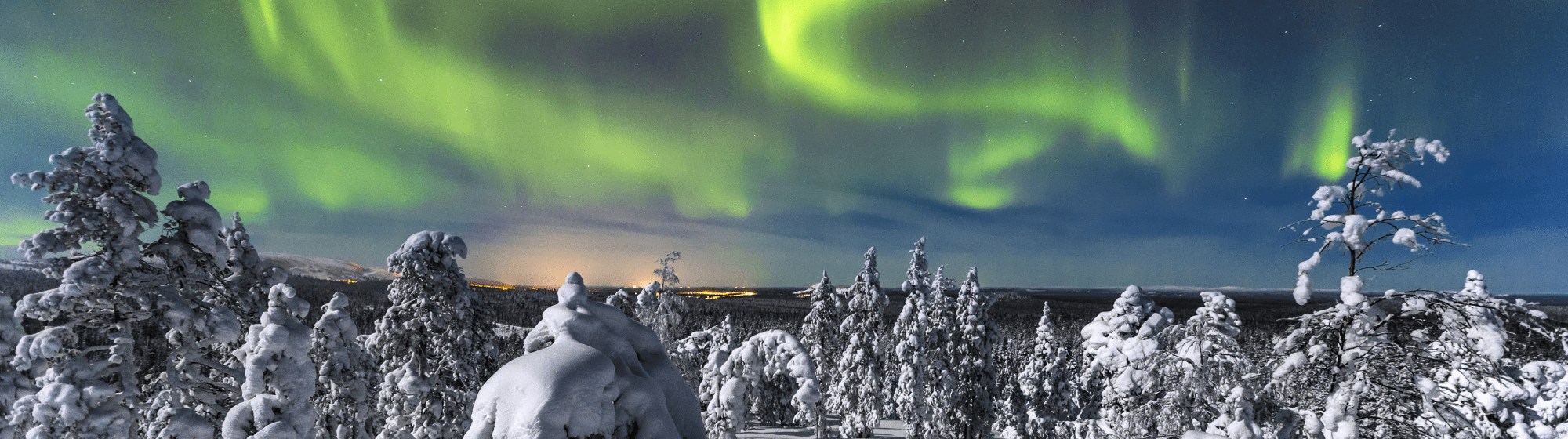
The sky bursts into flames in the middle of the night. Magnificent, vibrant colours ranging from pink to red, through every shade of green and blue, undulate and dance all around you. The show is breathtaking. You have just seen the Northern Lights, and no one can describe the emotion you feel when faced with the intensity and beauty of this phenomenon. Yet it is not a magician who has just struck the sky with his magic wand, but nature at work. The Northern Lights are physical phenomena that are now well understood by scientists. They are formed in the sky when solar storms collide with particles in the Earth’s atmosphere. Normally, the Earth’s protective magnetic field deflects these particles. However, when a solar flare is very powerful, the excess particles released pour into the atmosphere near the poles and create the Northern Lights.
When can you see the Northern Lights?
The best time to see the Northern Lights is generally between 21 September and 21 March in the northern hemisphere. However, in some regions, such as Norway, it is possible to see them from the end of August right through to the beginning of April. To get the best view of them, wait until night falls, make sure the sky is clear and get away from any light pollution. Depending on the intensity of the aurora, you’ll be able to see them from 6 pm until 2 am, and sometimes even later. November and December are less favourable months for observing them, as the sky is likely to be cloudier at this time of year. On the other hand, from September to mid-October, the days are still long and the nights are milder and clearer. You can also visit in February and March to see the Northern Lights against a snowy backdrop. But whatever the time of year, the secret to a good spot remains patience!
Where can you see the Northern Lights in Europe?
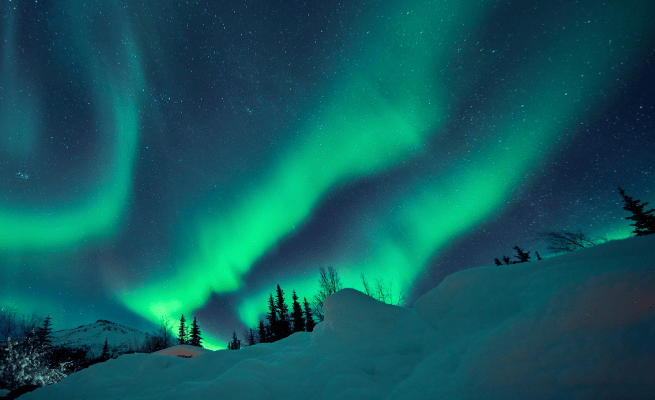
The Northern Lights can be seen in the northernmost regions of the planet, beyond the Arctic Circle. The areas between 65 and 75 degrees north are the places in Europe where you are most likely to spot them.
Northern Norway: easily accessible viewing spots
Situated at a latitude of 69° north, the city of Tromsø, Norway’s Arctic capital, is an excellent spot for viewing the Northern Lights. The town is easily accessible as it has an airport. From Tromsø, you can also take a flight to the Lofoten Islands, which, like all the islands in this region, offer excellent viewing opportunities.
Northern Lapland: the Northern Lights in the land of Father Christmas
Lapland is the region that covers the whole of northern Europe. It extends beyond the Arctic Circle across four countries: Norway, Finland, Sweden and Russia. All the towns and villages in this area are ideal for birdwatching.
- In Finnish Lapland, you can head to Ivalo, Inari or Kilpisjärvi. Finland’s flat landscape, dotted with lakes and forests, will give you a perfectly unobstructed view to admire them. And who knows, you might even bump into Father Christmas.
- In Sweden, the most commonly mentioned towns are Kiruna and Jukkasjärvi, as well as Abisko, which is situated in the driest and least cloudy region of Sweden. An observation station, the Aurora Sky Station, has in fact been set up there.
Iceland: a paradise for Northern Lights enthusiasts
Iceland is a top destination for fans of the Northern Lights. You can see them just about everywhere in Iceland. Some places are easier to reach and more photogenic than others, such as Jökulsárlón Lake or the Seljalandsfoss and Skogafoss waterfalls. The town of Akureyri is also renowned for these sightings. To put it simply, you could stay in Reykjavik, the capital of Iceland. You’ll still need to get a bit away from the city lights, though. The Seltjarnarnes Peninsula and the Reykjavik lighthouse are places where locals like to gather to watch the Northern Lights.